Inside the graph. Built to think like a rainmaker.
Lawyers build trust through warm relationships and great work, making traditional GTM outbound tools uneffective for the industry. Wimbly builds a graph for each lawyer and ingests relationship data, context, and signals. Agents can reason over the graph to proactively identify new matter opportunities specific to their ideal client profile.
5 min
A PE has deployed more than 80% of its fund II. Your former general counsel switches companies. A new regulation dropped. The hot new startup is on track to raise its Series A.
By morning, each of those events already sits in Wimbly’s signal graph. The PE fund links to its fund details, GP, the LPs with disclosed checks, and the closings that came before. The general counsel’s move connects the firm she left, the firm she joined, and the matters she touched at each. The new rule anchors to its regulator, the industry it hits, and clients with active exposure.
That’s the substrate Wimbly reasons over. Not a stream of unstructured text. Not a vector database of raw documents. It’s a typed graph of people, firms, matters, activities, and the relationship between them. Built signal by signal.
Documents are not the substrate.
Everyone in legal AI is asking some version of the same question right now. If foundation models can read a whole document corpus and recall every clause, why does the underlying substrate still matter? Don’t long-context models eat the application layer? Doesn’t retrieval-augmented generation (RAG) cover the rest?
I’ve heard the pitch. RAG everything. Throw documents at a long-context model. Wrap it in a chat box. Ship.
For some tasks I agree with more of it than you’d expect. Read a contract. Summarize a brief. Find the indemnification clause. A long-context model with retrieval works fine there.
But business development isn’t a document task. It’s a relationship task. Who knows whom. Who worked on what. Who’s about to move. Who you have a warm connection with.
None of that lives in a single document. It lives in the connections between thousands of them: the hundred entities those documents are silently about, the activity history of every person and firm involved, the shared interests, the mutuals, the warm angles, the partner’s own history with each. Documents are downstream of that graph. Most of the value sits in the connections, not the prose.
So we built the graph first.
“Documents are downstream of the graph. Most of the value sits in the connections and signals, not the prose.”
The signal graph is the firm’s brain.
The graph has four layers, built from the bottom up. But four layers is the wrong way to think about it. Think of it as one brain.
Most firms scatter their intelligence across email, the CRM, the billing system, the document management system, and the partners who happen to remember things. None of those systems talks to the others. None knows what the others know. So the collective knowledge of the firm exists only in its loosest, least useful form: what every partner knows about every client, every matter, every relationship, every signal, none of it in one place.
Wimbly consolidates all of it. Every signal, entity, relationship, prior matter, and voice profile into one typed substrate. Refreshed daily. Queryable in milliseconds. The agent uses it to proactively originate new matters across prospects and existing clients.
“The signal graph is the brain. Everything the firm knows. In one place. Live.”
Reasoning isn’t generating answers. It’s traversal.
The hard part of legal AI isn’t generating text. Models can do that. The challenge is reasoning over the right substrate with the right discipline.
Answers have to be traceable. Privileged information has to hold across every step. Some people can never see certain matters — that’s what conflicts of interest and ethics walls mean. The cost of getting it wrong is high enough that “the model usually gets it right” isn’t a safety story. The reliability lives in the orchestration layer, not the model.
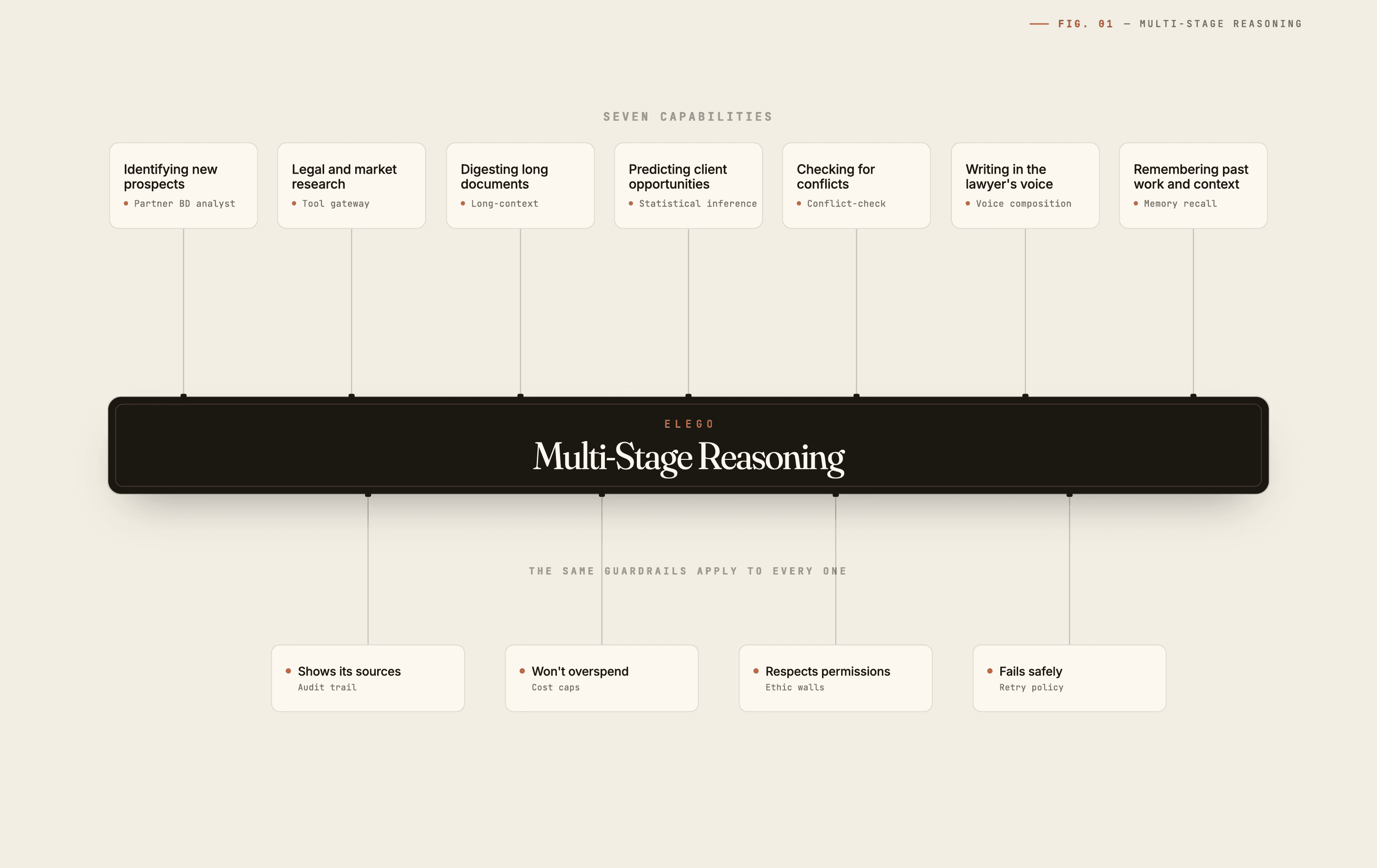
So Wimbly doesn’t take a prompt and run it through a model. The agent traverses the signal graph in a sequence of typed steps, where each step has a defined job, takes the previous step’s output as its input, and carries its own access classification, cost budget, retry behavior, and exit conditions.
We call this Multi-Stage Reasoning. MSR.
Take the business development analyst. An incoming signal kicks off four steps: figure out which people and clients are involved, place the event in time, run a targeted deep research pass, then apply what we know about the prospect (interests, mutuals, relationships, context) and route the result to the counsel best positioned to win the deal. A human can do this, but only for a few instances a week before the volume buries them.
Ethics walls aren’t features. They’re properties.
Privilege and conflicts aren’t bolted on top of the graph. They’re properties of the graph.
When the agent traverses the graph for a partner, the access ceiling of that session gets checked at every read, at every step. A partner walled off from a matter can’t see derivations built from it. A second-chair attorney with limited access can’t escalate himself by asking the agent.
The MSR contract carries that same discipline through reasoning. Each step declares the highest access class it touches. If a downstream step would silently lower that class, the pass stops. The whole sequence either honors the ceiling or refuses to run.
Hedge-fund-level data, for law.
Hedge funds figured out that data is the new oil thirty years ago. Information edge compounds. So they built infrastructure for it: Bloomberg terminals, alternative data providers, satellite imagery, credit card panels, real-time signal ingestion, pre-computed predictors across every name on the tape. They spend more on data than most law firms spend on real estate. They do it because the marginal correct answer in a position pays for the whole stack.
Law never built the equivalent. The biggest firms in the world still run business development out of CRMs that haven’t materially changed in twenty years, and spreadsheets partners don’t have time to update. The information asymmetry between hedge funds and the world is one of the most expensive moats in finance.
“The informational asymmetry between a law firm and its own collected knowledge is one of the most expensive missed opportunities in the practice of law.”
Wimbly is closing it. Pre-computed relationships and mutual connections across every entity the firm knows about. Daily graph recalculation. Agent-ready access. Coverage of every public signal that matters for BD, tied to the partner’s actual network, interests, commonalities, and prior work. Not a generic lead-list.
— Mattia

Article written by
Mattia Ros, Co-Founder